

Victory
February 25, 2026
Cutting Peak Energy Costs with Demand Response
Reducing demand is faster, cheaper, and cleaner than building new supply
By Karsten Neumeister, Media Relations Specialist
Electricity demand is rising in ways no one predicted a few years ago. Data centers, electrification, and expanding digital infrastructure are driving sharp increases in usage that utilities can’t easily forecast or meet. This surge is already showing up in higher electricity bills, and it is breathing life into fossil fuels.
The typical response to this problem is to build more power plants. While new power plants add supply, they are expensive to build, time-consuming, and often delayed by permitting and construction challenges. Relying solely on new plants locks us into these high costs and long, often uncertain, timelines.
If Midwest leaders want to keep our electricity prices stable without sacrificing public health, we need solutions now—not years from now. Luckily, we have solutions at hand.
Good Energy Policy Manages Supply and Demand
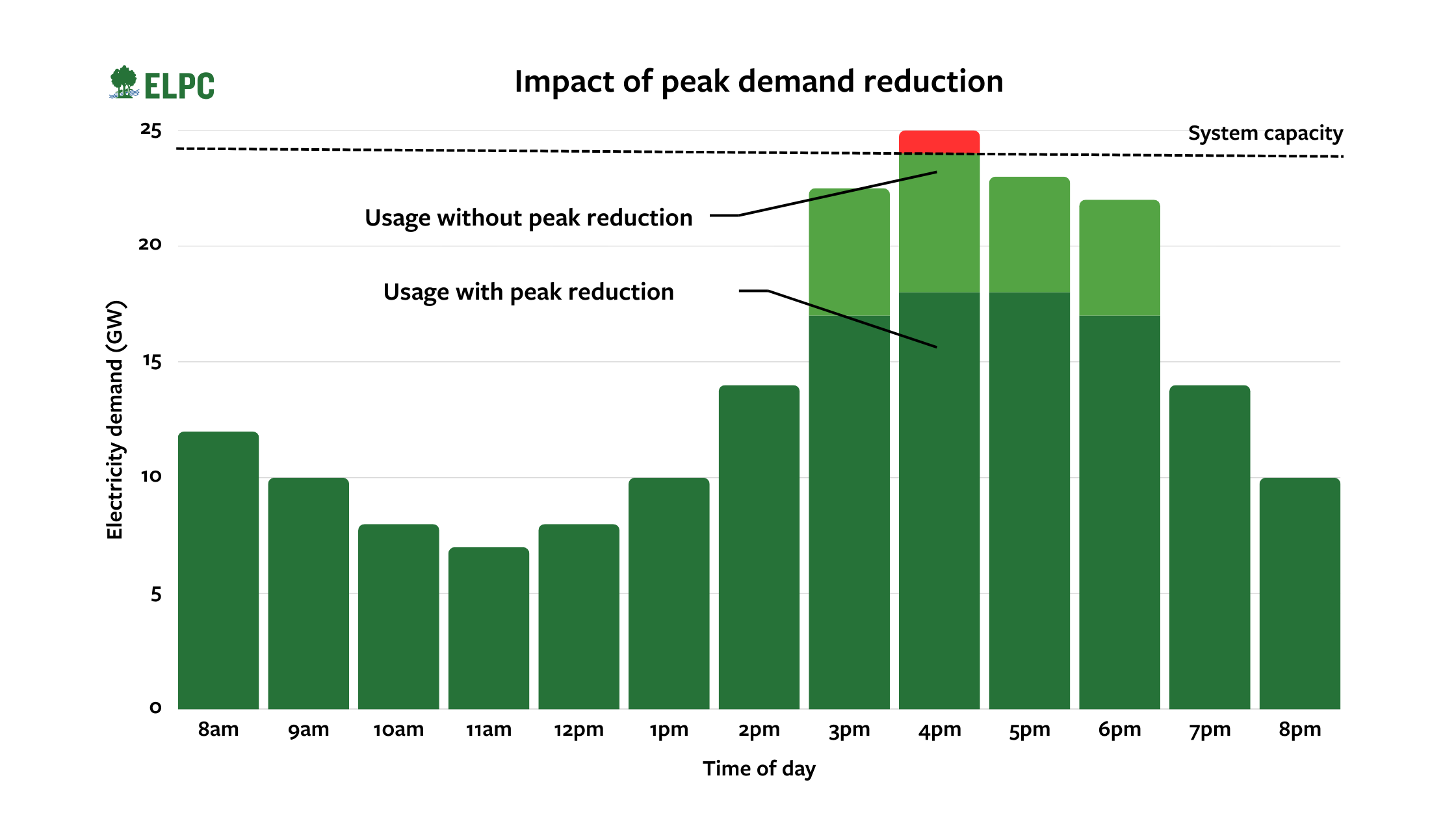
A smarter—and often overlooked—approach to today’s challenges is to reduce demand, especially during peak periods when the grid is nearest its capacity. As they say, the cheapest kilowatt-hour is the one you don’t use.
Reducing demand is faster, cheaper, and cleaner than building new supply. It lowers customer bills, reduces the need for costly grid upgrades, and limits reliance on fossil fuels. Best of all, demand reduction programs can be implemented in as little as one-to-two years, while a gas plant, for example, typically takes at least five.
What Is Demand Response?
One of the most powerful tools for reducing peak demand is demand response (DR).
Demand response programs incentivize customers—from homeowners to large industrial users—to temporarily reduce or shift electricity use during periods of high demand. A data center might pause nonessential computing tasks, while a manufacturer could delay energy-intensive processes until off-peak hours. A residential customer would just turn the thermostat back a few degrees during peak hours. In return for voluntary participation, customers receive bill credits or direct payments.
For the grid, demand response means improved reliability from less strain during critical hours and reduced need for additional generation. For customers, it means lower costs and greater control over energy use. For the environment, it means less dependence on “peaker” gas plants, those that run only during peak events. These power plants are not only the most expensive, they are also the most polluting.
Participation is Always Voluntary
Demand response programs are completely voluntary. Customers choose whether to participate and can opt out at any time. Large industrial or commercial users decide how much load to reduce during peak hours, while residential participants might have smart thermostats adjusted automatically, but the resident keeps the ability to override anytime. Customers are paid or credited for their participation, so everyone keeps control while helping lower costs and reduce strain on the grid.
What Is ELPC Doing?
How demand response is deployed varies by state, and policy can either enable or block its use. ELPC is removing barriers to these programs across the Midwest to lower bills for households and avoid locking into new fossil fuel plants.
Victory in Iowa
Customers interested in participating in demand response programs typically do so through their local utility. However, it’s also possible to work with third-party companies that specialize in demand response. Working with a third-party “aggregator” offers customers more choice, more competition, and more ways to save money than only through a utility program.
Until recently, however, Iowa did not allow third-party demand response aggregators. ELPC stepped in to change that, and in late 2025 the Iowa Utilities Commission ended the ban thanks to our advocacy. For now, this new option is available for primarily larger commercial and industrial customers.
Iowa’s experience offers a lesson for other states. As energy-intensive facilities like data centers expand nationwide, traditional supply alone cannot manage peak loads efficiently. States that allow third-party innovators, incentivize flexible load, and integrate demand response into planning can reduce peak demand faster and at lower cost than relying solely on new generation.
Progress in Ohio
In Ohio, in response to its sharply rising electricity prices, ELPC helped introduce House Bill 427, a bill to create voluntary demand response programs for residential and small commercial customers in Ohio. The bill is part of Ohio’s strategy to meet higher demand for electricity and help lower costs for customers. Under this specific demand response program, utilities offer customers money in return for allowing the utilities to turn back their smart thermostats, water heaters, or other devices.
Participation is completely voluntary, and customers can override the changes at any time. According to the Midwest Energy Efficiency Alliance (MEEA), statewide demand response programs would create estimated net savings of between $34.5 million and $104 million for Ohio’s utility system, depending on participation rate. This does not include savings from reduced utility spending on infrastructure like transmission and distribution.
The Bigger Trend
Reducing demand is no longer optional—it’s essential. As electricity use grows and becomes harder to predict, states cannot rely on new generation alone to keep costs down and lights on.
Demand response offers a proven, affordable way to meet today’s challenges. States that remove barriers, encourage flexible load, and integrate demand response into utility planning can protect consumers, improve reliability, and avoid locking themselves into decades of unnecessary fossil fuel investment.

Karsten Neumeister,
Media Relations Specialist
Karsten Neumeister serves as a Media Relations Specialist at ELPC, collaborating with the press to educate the public about clean energy and climate-related issues in the Midwest.
MORE FROM Karsten Neumeister