
Testimony
January 28, 2026
Homegrown Solar Energy Strengthens Rural America
By Karsten Neumeister, Media Relations Specialist
Across rural America, farmers, businesses, and landowners are turning to solar as a dependable, low-risk power source. Renewable energy like solar is now the nation’s lowest-cost form of electricity, and thanks to its simple infrastructure, it’s also the fastest to build.
With its expansive, open flatlands, the Midwest has become a prime location for utilities, developers, and communities to build solar farms. It’s also common for farmland owners to lease portions of their land to solar developers, earning stable income that buffers volatile crop prices and helps keep farms together rather than sold or developed.
As solar grows, debates emerge about its role on agricultural land. Some counties have even considered bans over concerns about inefficient land use. But when solar is thoughtfully planned and paired with strong land stewardship, it doesn’t compete with agricultural land — it enhances it — improving soil health, restoring wildlife habitat, reducing air and water pollution, and improving the efficiency of farmland already used for energy production.
An Iowa Farmers Perspective
As the Iowa Utilities Commission (IUC) considers a proposed 500-MW solar array in Cerro Gordo County, many local voices are weighing in — including Terry Kucera, a lifelong Iowan and farmland owner from Sergeant Bluff, who filed written testimony on behalf of ELPC.
Terry reminded the commissioners that Iowa farmland has long been used for energy production through ethanol, and that solar is simply a better form of homegrown energy — one that uses less land and protects the soil beneath it.
He also spoke to a core principle of family farming and American life – property rights. For many landowners, lease payments offer stability and flexibility, allowing them to diversify their income and keep their land in agricultural production. Farmers should be able to decide how best to use their own property. That includes the choice to host solar.
The Benefits of Integrating Solar into Farmland
Terry’s testimony illustrates how solar can deliver both economic and environmental benefits for agricultural communities. Below, we explore those key benefits.
- Economic Benefits
For many utilities, farmers, and businesses, the most immediate and meaningful benefit is financial. Solar, particularly utility-scale, is the least expensive form of energy to build. For farmers and landowners leasing portions of their land, payments provide reliable, long-term income. Together, these benefits help to:
- Diversify revenue and provide certainty in agricultural economies
- Create construction and agricultural jobs
- Keep marginal or low-productivity acres profitable
- Generate significant tax revenue for local governments
Farm-scale solar systems, often supported by programs like the Rural Energy for America Program (REAP), can also significantly reduce electricity usage for barns, irrigation, grain drying, and other energy-intensive farm operations. In many cases, this dual benefit of lease income plus energy savings provides economic stability for rural communities.
- Improving the Efficiency of Energy Generation
In Iowa, more than half of all corn is grown for ethanol. In Wisconsin, that number is about 40%. This means farmland is already being used to produce energy — but through monoculture systems that require intensive water use and often contribute to nutrient loss and nitrate contamination in groundwater.
Utility-scale solar also uses land to generate energy, but far more efficiently and with significant environmental benefits. Compared to producing ethanol from corn, solar power:
- Uses no water
- Is more than 70 times more efficient as a transportation fuel
- Generates energy without contributing to groundwater contamination or nutrient depletion
Because solar produces more energy with fewer environmental impacts, states can improve fuel diversity and strengthen grid reliability while maintaining acreage for both biofuels and traditional agriculture.
- Clean Air and Clean Water
Solar power reduces air and water pollution by replacing fossil fuels with emissions-free energy. Rural communities — often located downwind or downstream of power plants — benefit directly from cleaner air and cleaner water.
When solar projects incorporate deep-rooted native or pollinator-friendly vegetation, they deliver additional water-quality improvements by:
- Reducing nutrient runoff
- Lowering nitrate contamination
- Improving soil infiltration and reducing erosion
Together, these benefits support healthier aquifers, streams, and drinking water for rural communities and agricultural operations alike.
- Healthier Soil
Native prairie vegetation planted under and around solar arrays improves soil structure, increases organic matter, and protects against erosion. These deep-rooted plants help:
- Increase soil stability and water retention
- Rebuild degraded soils over time
- Support healthy soil microbiomes
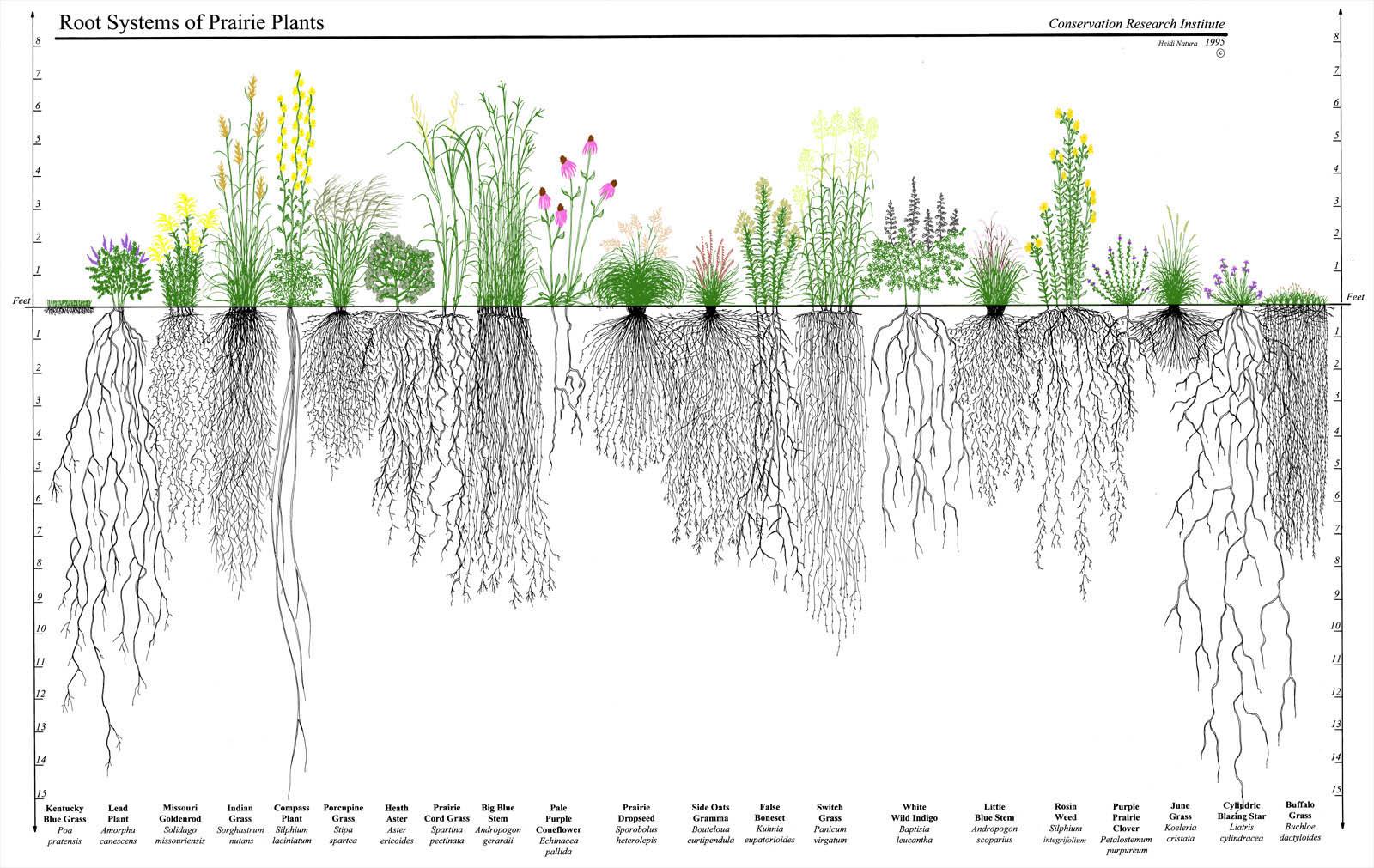
Root Systems of Prairie Plants. Source: Conservation Research Institute
With low-impact management practices like rotational sheep grazing (also known as agrivoltaics), solar sites often show measurable soil-health improvements within just a few years. When a solar array is removed, the healthier land can return to agricultural use.
- Habitat for Pollinators and Wildlife
Pollinator-friendly solar transforms fields into habitat for bees, butterflies, and birds, species that deliver real value to agriculture. Healthier pollinator populations can improve crop yields on nearby farms and strengthen local ecosystems.
Solar allows energy generation and land use to coexist. Examples include:
- Sheep or cattle grazing between panel rows
- Native grasses that support wildlife
- Cooler microclimates more resilient to heat and drought
Done well, solar delivers rural and agricultural communities a win-win. Farmers earn stable, diversified income, farmland stays productive, and local ecosystems’ health improves. Not all solar farms are created equal – but thoughtfully planned solar farms enhance habitat rather than removing land from agricultural or ecological productivity. By embracing solar, rural America can build a more resilient, sustainable future that benefits both the people and the land.

Karsten Neumeister,
Media Relations Specialist
Karsten Neumeister serves as a Media Relations Specialist at ELPC, collaborating with the press to educate the public about clean energy and climate-related issues in the Midwest.
MORE FROM Karsten Neumeister