

Amtrak Saluki, Illinois
Story
May 26, 2026
Congress, White House All Talk, No Action on Passenger Trains
Congress' new reauthorization proposal puts passenger rail future on shaky ground
By Derrick James, Senior Policy Advocate
Americans clearly want more trains to ride. Record breaking ridership on Amtrak and in Florida shows this, and Congress knows it. Then why did this Congress introduce two pieces of legislation that threaten to stall numerous projects across the nation? New railroad projects will give Americans the trains they want and need to save on travel, rebuild a domestic manufacturing supply chain, boost local economies, and reduce emissions.
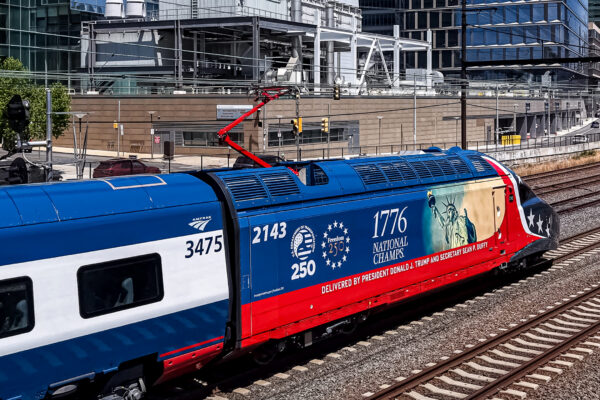 Despite the flashy press conferences and Trump branded trains, the President’s budget proposal slashes passenger rail funds, too. It seems Congress and the White House are reading from the same playbook: talk a good game about the value of passenger trains then do the opposite, thinking no one is looking.
We’re watching.
What is Transportation Reauthorization?
Every five years, Congress must pass new surface transportation legislation. It determines how federal gas tax revenue will be distributed and sets transportation policy and priorities for federal, state, and local governments.
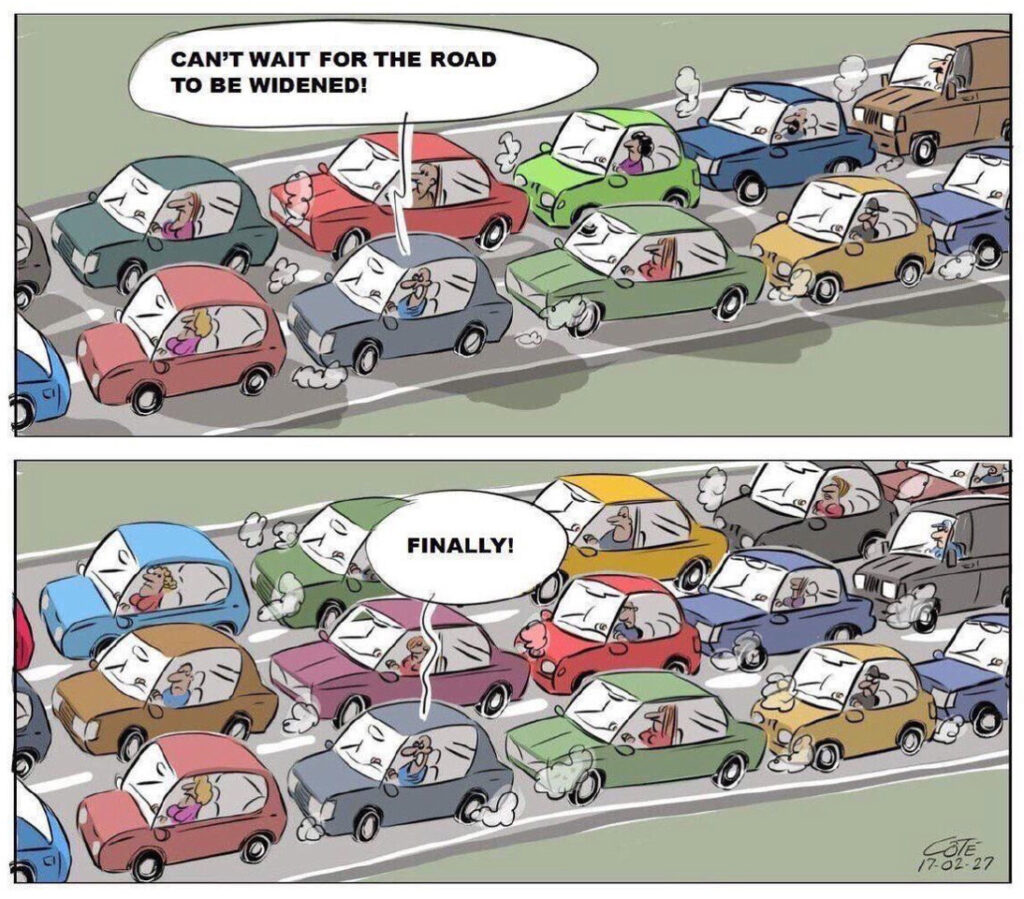 For decades, national transportation policy and expenditures have heavily favored more roads. When they get congested, the “solution” is to add more lanes, despite the evidence that more lanes only make congestion worse over time and wider roads make it more dangerous to get anywhere without a car. Forget about maintaining what we have or investing in efficient alternatives, politicians love a new roadway ribbon cutting! We see the results of that modal bias: more pollution, more death (45,000 died on American roads annually), more transportation expense for families (a new car now costs $50,000!), and non-drivers stranded and isolated in their communities.
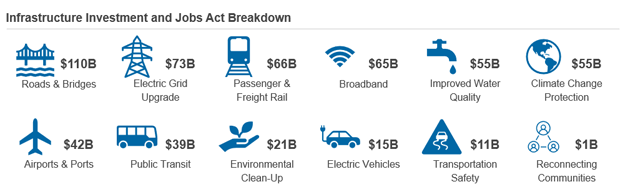
The last reauthorization package came much closer to shaping the multimodal, sustainable transportation future we need. The game-changing bipartisan Infrastructure Investment and Jobs Act of 2021 (IIJA) invested in passenger rail, sidewalks, bike paths, public transit, and safer streets, targeting much-needed repair work on existing roads and bridges across the country. It was not perfect, but it did a lot of good, and passenger rail has been booming since the new routes and rail cars started rolling out.
BUILD 250 Proposal
This week, the Transportation & Infrastructure Committee in the U.S. House introduced surface transportation reauthorization legislation that takes a big step backwards from the IIJA. The BUILD 250 Act (Building Unrivaled Infrastructure and Long-Term Development for America’s 250th) guts affordable walking and biking, imposes new fees on electric vehicle and plug-in hybrid drivers, and cuts $20 billion from public transportation. When it comes to rail, the BUILD Act lays out some positive reforms to speed project delivery, encourages innovative rail car fleet expansion, and keeps rail service corridor expansion programs. But it throws funding up in the air, putting the whole industry in limbo.
The bill sets authorized levels of $63 billion for rail over 5 years, but the problem is that word authorized. Think of an authorization as a target for spending, not the actual amount available. Providing the real money would be left up to the appropriations committees in Congress, who would have to fight it out every year to pay for the policy goals spelled out in BUILD 250. It’s like the difference between a wish list and a shopping list. That difference was starkly illustrated just three days later, when the U.S. House appropriations committee that handles rail proposed to slash railroad improvement funds by 89% versus this year, from $29 billion down to $3 billion, including gutting rail expansion grants to zero.
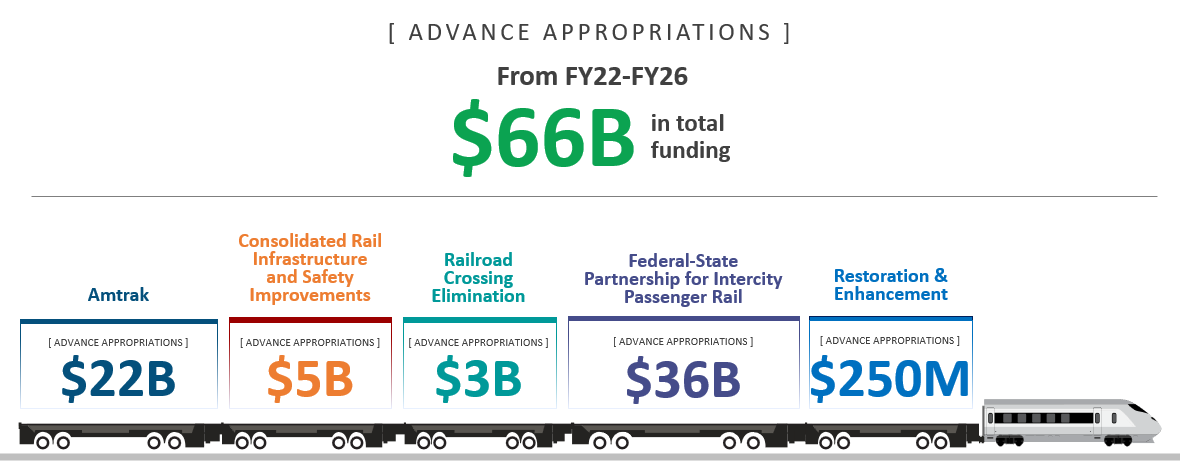
Advanced appropriations for passenger rail in IIJA, which would go away under the BUILD250 proposal. Graphic from Federal Railroad Administration.
IIJA solved the uncertainty around authorizations through “advanced appropriations” – setting aside real money for five years, thereby allowing Amtrak, states, and the rail industry to make multi-year investments knowing that the money was available. Sadly, Congress abandoned this important solution in BUILD 250. If it passes, we’ll return to the constant teetertottering ups and downs of annual appropriations that make it harder to build the trains Americans deserve. That’s no way to run a railroad.
The Impact on Midwest Rail Projects
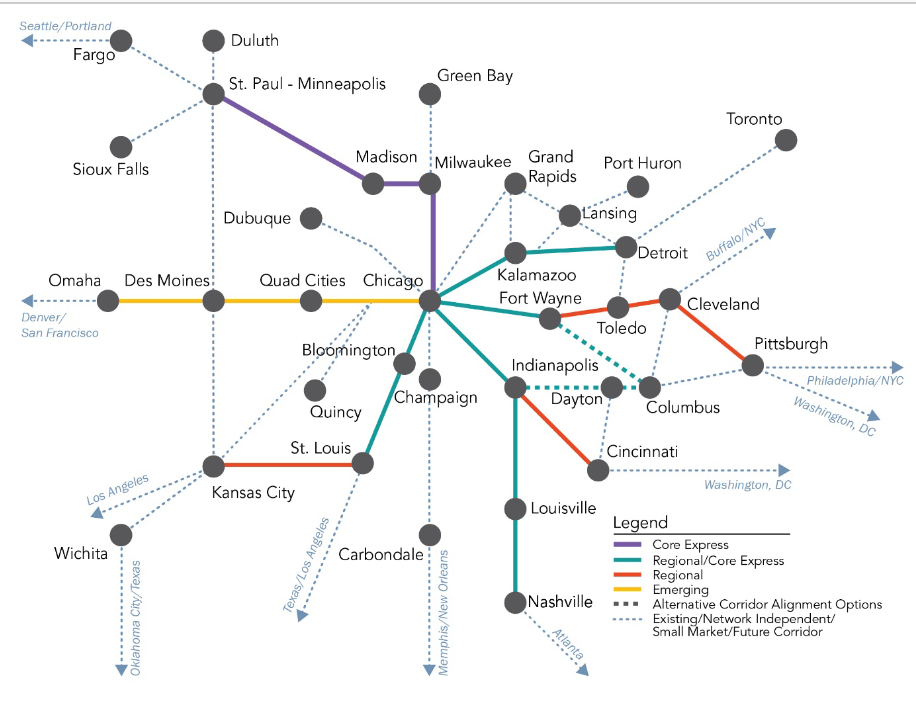
FRA Midwest Regional Rail Plan Network
There are a lot of great railroad plans underway as we speak. With advanced appropriations from IIJA, states and communities are busy planning for new rail routes to Fort Wayne, IN, Columbus OH, Madison, WI, Moline, IL, and more Midwest destinations. Groundbreaking will occur soon on new platforms at Chicago Union Station with plans for a grand concourse overhaul underway. New fuel efficient, low emissions trains are being placed into service. In BUILD 250, those programs would get but a fraction of the amount authorized based on the House-proposed 2027 appropriation budget. Congress giveth with one hand and taketh away with the other.
If BUILD 250 and the House 2027 Appropriations bill are enacted, our nation’s transportation policy would double down on failed priorities of the past: more dangerous roads, dirtier skies, more traffic, and less choice. In the face of skyrocketing transportation costs for consumers and businesses, growing public demand for alternatives to expensive cars, limited mobility for millions, and worsening air quality, the House has introduced legislation that would make our transportation system worse.
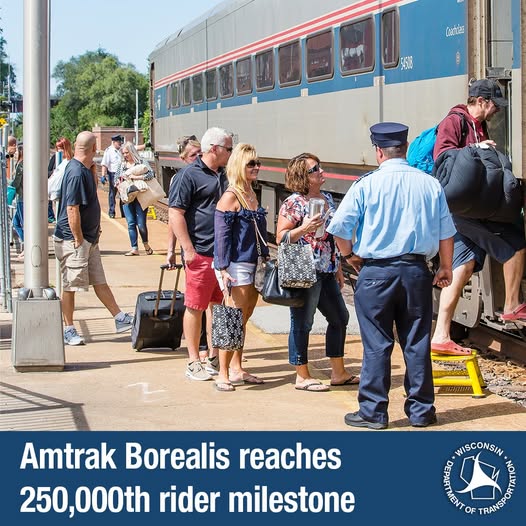 ELPC and our partners are going to fight to keep moving forward. IIJA once again demonstrated “if you build it they will come” as passenger rail policy changes were beginning to reflect a slightly more balanced approach. New trains, fixed up tracks and stations, safer crossings, and new service boosted ridership to record levels. New factories are opening to build more trains. We’re seeing the restoration of big-city and small-town train stations, returning them to the center of civic life and drivers of economic revival in our downtowns. We’re seeing new passenger trains added in Wisconsin, Minnesota, Alabama, Louisiana, Virginia, North Carolina and Mississippi. This week’s House and White House proposals could slow this great progress and stop some projects in their tracks. We can’t let that happen.
ELPC will continue to make the case at all levels of government that a robust, high quality passenger rail system is an achievable, unquestioned benefit to the people of the Midwest and the nation. The status quo is unacceptable if we want to achieve goals of a cleaner and more vibrant tomorrow for our communities.
Derrick James,
Senior Policy Advocate
Derrick James is a Senior Policy Advocate with ELPC focused on transportation issues.
MORE FROM Derrick James